Showing posts with label king. Show all posts

Monday, 19 November 2012

The Prince of Wales Camp Postmarks 1921-1922

The Future King Edward VIII on Tour


From 1919 to 1922, the Prince of Wales, the future King Edward VIII, embarked on a grand world tour. 

In 1921, the Eastern Tour commenced. The HMS Renown departed Portsmouth at sunset on October 26, with the Prince on the saluting deck. The ship called at Gibraltar, Malta, Port Said, Suez and Aden before arriving at Bombay on November 17. Four months later, on March 17, the Prince left India behind as the Renown sailed for Japan.

A commemorative postmark was used during the tour of the subcontinent, featuring the legend "H.R.H The Prince of Wales' Camp P.O." at the top, with the Prince of Wales feathers in the top centre, and seven bars on each side. The date and time are at the bottom centre, with a thick bar below
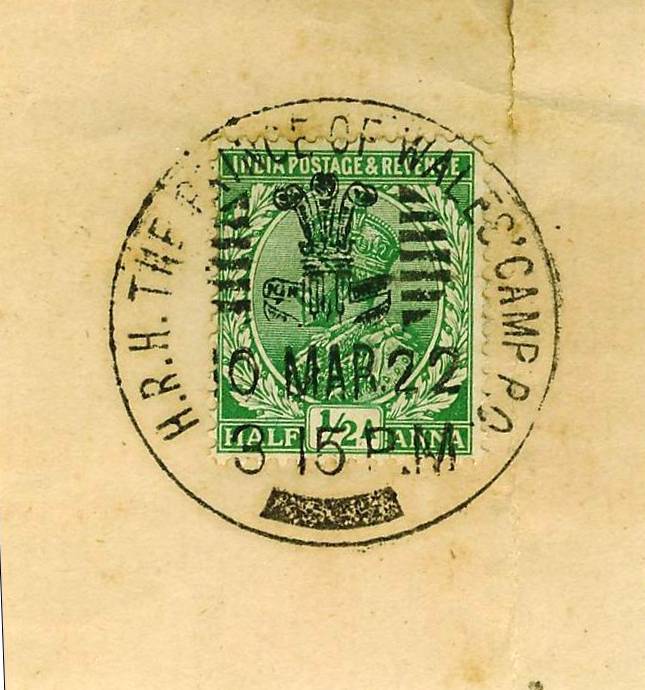

Although the postmark doesn't show a location, the tour itinerary makes it possible to ascertain where the postmark was used.

The itinerary was kindly provided by Kasinath Rajasekaran on the Global Philately Facebook Page, and reproduced here in full:

Friday, 9 November 2012

The 1935 Silver Jubilee - A New Discovery? A Further Update

The Research Continues.......


In my blogs of 22 June and 10 August, I discussed a possible new discovery on the 1935 Silver Jubilee issue.

Experts with experience far exceeding mine are still reviewing their holdings and are coming to different conclusions. However, a tentative sheet position has been suggested, as the variety has been sighted on a sheet of Plate 4 Northern Rhodesia and Plate 2A British Solomons

This line on the tower is the variety in question


To read the latest commentary, please visit Silver Jubilee Stamps. The latest information is at the foot of the front page.

As before, I would be delighted to hear from anyone with similar copies!

Friday, 10 August 2012

The 1935 Silver Jubilee - A New Discovery? UPDATE

Another Example of an Unlisted Variety?

In my blog of 22 June, I showed an example of a potential new discovery on Northern Rhodesia SG21, the 6d  Silver Jubilee issue. It takes the form of a "derrick" on the Round Tower, left of the flagstaff


I'm pleased to report that I've located another, very similar, example on a commercial site, which I've just purchased. However, this is on SG19, the 2d value.


I'm intrigued by this variety, which is far more visible than some of the listed varieties on the Silver Jubilee Omnibus issue

My search will continue for more, and I would appreciate any and all information for further research.

Specifically, as a sheet position would be needed to confirm this as constant, or semi-constant, it would be ideal if it showed in a positional block. If you have any holdings, please check them!

Friday, 22 June 2012

The 1935 Silver Jubilee - A New Discovery?

An Unrecorded De La Rue Variety?

The 1935 Silver Jubilee of the reign of King George V (whose Coronation was held on this day in 1911), was commemorated by a series of stamps with common design. My earlier blog regarding the series can be found here.

The stamps were printed in a two-part process (except for Newfoundland), with a frame plate and a vignette. Unique varieties exist for all three printers. There are superb reference sites here and here that show all of the major, and many of the minor varieties.

I recently found three stamps printed by De La Rue that seem to show a common variety, in three different stages, for which I've found no other reference.

The stamp that shows the flaw most prominently is the Northern Rhodesia 6d (SG21). The flaw takes the form of a large bird, or a reversed tick-mark, on the left edge of the Round Tower


Friday, 25 May 2012

1935 Silver Jubilee Omnibus Issue

The stamps and postal history of King George V (1910-1936) are my major areas of interest. The classic designs have never been matched in my view.


The 1935 Silver Jubilee series, and the numerous varieties to be found, are my favourite issues and a particular focus of study.

A total of 44 colonies subscribed to this issue, (creating the first Empire/Commonwealth Omnibus issue) with all except Newfoundland printing in two colours with a central vignette.

Three printers were employed for the task, Bradbury, Wilkinson & Co, De la Rue & Co and Waterlow & Sons. The stamps were recess-printed, and although a common design was used, the varieties are particular to the relevant printer's plates